
Whether you're baking from an old Australian cookbook, a family recipe card or an overseas website, converting measurements and understanding ingredients and culinary terms can be confusing. This baking resources hub is here to help you decipher recipes no matter where they're from. Here, you'll find all the most useful conversion charts, calculators, tools and tips.
Jump to:
Printable kitchen conversions chart
The Cooking with Nana Ling "Kitchen Measurements made easy" highlights some of the most useful measurement conversions required when working in the kitchen. Print it out and add it to your recipe folder or pin it to the fridge.
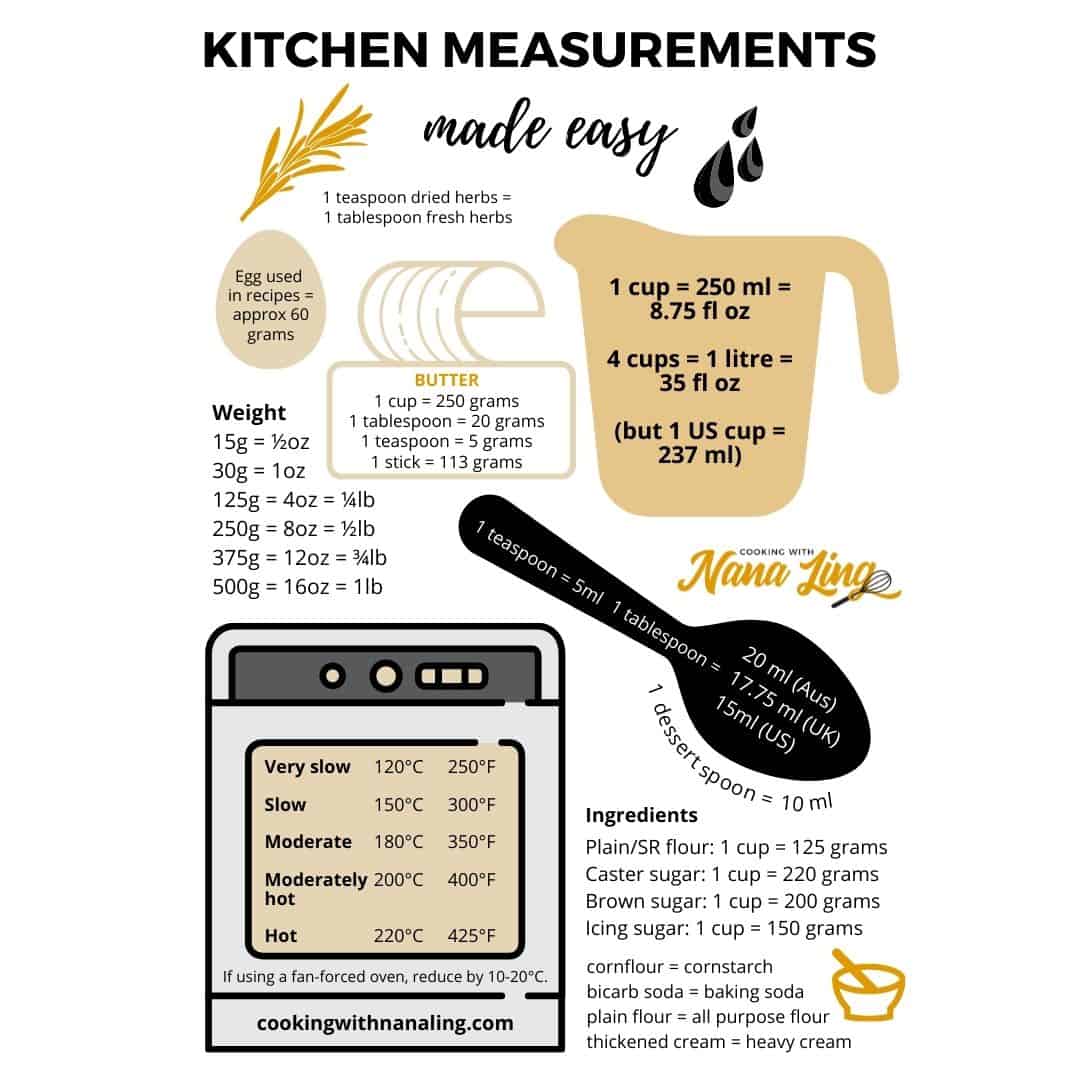
Oven temperature conversions
| Description | degrees celsius | degrees fahrenheit | Gas Mark |
| very slow | 120 | 250 | ½ |
| slow | 150 | 300 | 2 |
| moderate | 180 | 350 | 4 |
| hot | 200 | 400 | 6 |
| very hot | 220 | 425 | 7 |
Add 10 or 20 degrees when using a conventional oven with fan-forced temperatures. Subtract 10 or 20 degrees when using a fan-forced oven with conventional temperatures.
Quick conversion tools
Grams ↔ Ounces Converter
1 ounce = 28.3495 grams
Use this simple grams to ounces converter for baking and cooking measurements.
Celsius ↔ Fahrenheit Converter
Formula: °F = (°C × 9/5) + 32
Use this simple celsius to fahrenheit converter for oven temperatures.
Weight vs volume measurements
In home cooking and baking, ingredients are measured in two main ways: weight (grams, ounces) and volume (cups, tablespoons, teaspoons). While both are widely used, they are not always equally accurate.
When home cooks convert recipes between weight and volume measurements, problems often arise because, for example, a "cup" is not a fixed weight:
- 1 cup of flour ≠ 1 cup of butter ≠ 1 cup of sugar (in weight)
Why weight measurements are more accurate
Weight measurements (grams and ounces) are considered the gold standard in baking because they are precise and consistent.
For example:
- 1 cup of flour can vary depending on how tightly it is packed.
- 1 cup of shredded coconut weighs differently to 1 cup of caster sugar.
- Things like humidity can slightly affect how much an ingredient weighs when measured by volume.
Using a kitchen scale removes this guesswork completely. This is why professional bakers almost always measure ingredients by weight.
Why volume measurements are still common in home kitchens
Volume measurements (cups and spoons) are still widely used because they are:
- Faster and easier for casual cooking
- No kitchen scale required
- Standard in many traditional and older recipes (especially Australian and US recipes)
However, they are less precise, which can lead to inconsistent results — especially in baking. Small measurement differences can affect:
- Cake texture (dense vs light)
- Cookie spread
- Slice firmness
- Rising ability of baked goods
That’s why recipes that include gram measurements alongside cups tend to be more reliable.
Best practice for home cooks
For the most consistent results:
- Use grams for baking whenever possible
- Use a digital kitchen scale
- Treat cup measurements as a guide, not a precision tool
Cooking with Nana Ling recipes
At Cooking with Nana Ling, I try to include both metric and imperial measurements to make recipes accessible to everyone — whether you're baking in Australia, the US, or anywhere else in the world. Where possible, I recommend using the gram measurements for best accuracy, especially in baking. Some of the older recipes may not include both. If that's the case and it's causing confusion, comment on the recipe and I'll update it ASAP.
Butter measurements
In Australia, we generally have blocks of butter that are equivalent to a cup of butter (250 grams). In the US, sticks of butter are more common with 2 sticks equal to a cup of butter (226 grams). That's right, to make things more confusing, an Australian cup is different from an American cup!
| Country | Blocks/Sticks | Metric | Imperial | Cups |
| Australia | 1 block | 250 grams | 8.8 ounces | 1 cup (Aus) |
| US | 2 sticks | 226 grams | 8 ounces | 1 cup (US) |
Using Australian recipes
Wondering what caster sugar is? Didn't know you might get in trouble for calling a biscuit a cookie in Australia? Yep, you need to read my guide to using Australian recipes. You might also want to brush up on your Aussie slang if you're reading one of my posts, too.
Making Australian slices
Slices are a much-loved part of Australian home baking, but the terminology, tin sizes and techniques may be unfamiliar—particularly if you’re baking outside Australia.
My complete guide to making and baking Australian slices explains what an Australian slice is, how to choose and prepare a slice tin, create even layers, cut slices neatly and store them properly. You’ll also find a little slice history and plenty of recipes to try.